| |
Propeller boats
waste a lot of fuel and much of this waste can be eliminated. In brief,
IntelliJet does three things better than propellers: 1) it operates the
motor more efficiently, so the motor delivers more shaft power for the
fuel it consumes; and 2) it controls the flow of water through the
propeller, so the propeller converts more shaft power into hydraulic
power; and 3) it minimizes the velocity of the discharge jet, so that it
produces more thrust force from a given hydraulic power.
1)
In a common propeller or jet boat the motor only operates at peak
efficiency close to full power. At lower speeds, the power demanded by
the propeller is well below the power that would be most efficiently
supplied by the motor. This would be unthinkable in your car, like
driving down the freeway in second gear. Imagine what that would do to
your gas mileage and to your motor life. That’s just what happens in
most boats, but not in an IntelliJet boat.
2) A fixed
propeller of conventional jets is relatively efficient only in a narrow
range of operating speeds and loads. In fact, some people commonly
change propellers for carrying different loads or running at different
speeds. Larger boats and ships like US Coast Guard Cutters use
controllable pitch propellers to operate more efficiently over a wider
range of speeds and loads.
|
|
Jets have a reputation for using more fuel,
because they cannot easily be changed, and are particularly inefficient
away from their ideal speed and boat load. IntelliJet addresses all of
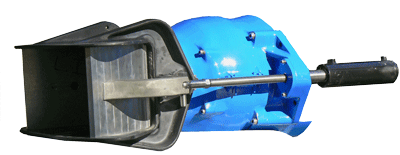
these efficiency issues by using a controllable pitch propeller pump, a
controllable nozzle to vary the jet size, and a controllable inlet to
efficiently deliver the required flow to the propeller.
3) At very low
speeds, if the jet velocity is reduced by 50%, the thrust is doubled for
any given hydraulic power. If the motor and pump efficiencies are
constant, the same amount of fuel is required to produce a given amount
of hydraulic power, so fuel consumption is reduced by 50% in the lower
jet velocity.
The IntelliJet is
controlled by a computer to realize all of these savings over a wide
range of boat speeds and loads, and they add up to significant savings.
You will find technical
papers on the
IntelliJet Links page that address
these issues in more detail.
|
|
| |
The same design features
that protect people from contact with the propeller also protect the
propeller from damage related to contact with rocks and logs. The hull
must be pressed flat against the bottom to provide a means of sucking up
rocks, and who wants to hear rocks scratching along the bottom of an
expensive boat? Even then, a rock the size of a tennis ball will pass
through the system without binding. The system will be equipped with a
grate to prevent the larger pieces from getting in there in any event.
There is a greater
probability of getting a waterlogged piece of wood into the system. If
such debris causes a bind between the propeller blade and the stator
vanes, the return spring in the actuator will act to relieve it, and the
computer can detect the consequent hydraulic pressure drop pressure to
sound an alarm. It will be a rare piece of waterlogged wood that will
have the ideal size, shape and strength to slip through the inlet grate
and damage the pump, although it will no doubt happen on rare
occasions.
If the system sustains
damage, it can be quickly fixed and returned to service. The pump
module weighs less than 100# and is a convenient size and shape to be
exchanged by UPS. It can be exchanged on the boat by the boat owner in
probably less than an hour. (See IntelliJET
Modular Replacement video on home page under "How It Works".) This module
contains most of the precision fits in the system, as it includes the
tapered roller bearings, shaft, actuator, and pump propeller. Any
damage that would result from getting a log into the system would be
likely to occur in this module.
The nozzle module is
above the bottom of the hull and in the path swept by the hull in
forward motion. The only way to damage it is blunt force trauma
resulting from backing the boat into the shore. It will generally be
protected from contact with the dock by the swim platform above it, so the
swim platform will sustain damage before the nozzle does. The nozzle
module will also ship by UPS and can be replaced by the owner in about
15 minutes.
|
|
It is easy to see that
this beats any propeller system for prevention of damage, ease of
repair, and minimum down time.
There is a surprising
perceptual problem related to jets, even though they are considered
extremely durable in the aluminum jet river boats used in the West,
where many boats haven’t had an incident in years of operation in rocky
river bottoms. It turns out that teenagers on jet skis are a different
story: the thrill of gunning it in shallow water is too great to resist.
Many people have had bad experiences with the consequences of rocks
getting into their personal water craft that they wonder if the
IntelliJet will suffer similar problems. In fact, PWCs are not designed
for operating in the shallows and the resulting damage is not covered in
their warrantee. Looking at the four-figure bill just makes the owner
mad and that anger is transferred to all jets. Again, the IntelliJet
will pass rocks and branches that would jam and break the impeller of
the much smaller PWC jet.
When the boat is in
forward motion, the hull sweeps debris off to the side out of the way
and also knocks floating debris down out of the suction path of the
inlet of any jet. Many jet boat manufacturers do not recommend the use
of an inlet grate, pointing out that it creates a loss of power that
makes the installation less efficient, so that the value of the fuel
consumed is far greater than the risk of damage from anything getting
into the jet.
|
|