| |
The development of IntelliJet Marine, Inc.
began when Jeff was considering the purchase of a manufacturer of
aluminum jet river boats. As a result of his experience in the design
and manufacture of small commercial hydroelectric systems, he observed
several causes of hydraulic inefficiency in marine jet propulsion
systems. Any such inefficiency is rigorously attacked in the
hydroelectric business -- it translates into power not generated
and revenue lost. In jet boats it translated into the need for a
flatter hull, a rougher ride, a bigger motor, and a bigger fuel tank.
The application of
hydroelectric-turbine-design principles to jet boats resulted in three
broad patents covering the inlet, pump and nozzle control conditions
that must be maintained for efficient marine jet propulsion.
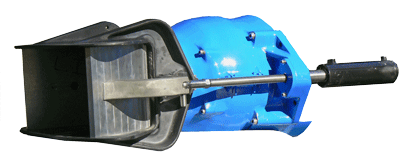
Jordan’s fourth patent in the field of marine jet propulsion goes to the
use of a controlled variable pitch propeller pump in combination with a
controlled inlet and nozzle to maintain efficient propulsion over a wide
range of boat speeds. |
|
In
jet boats (inefficiency) translated into the need for a flatter hull, a rougher
ride, a bigger motor, and a bigger fuel tank.
Jordan presented this technology at the
Advanced Naval Propulsion Symposium 2008 in Arlington VA,
concluding that
IntelliJet technology will be much more fuel
efficient than propellers or conventional marine jets in a wide range of
boat and fast-ship designs.
Jeff has served as President of the
Northwest Venture Group based in Seattle, Washington. His background
includes a BA from the University of Colorado, service as an officer in
the US Navy and an MBA from the University of California. In the Navy,
Mr. Jordan was the Communications Officer on a refrigerated stores ship,
which supplied forces along the coast of Viet Nam. |
|